
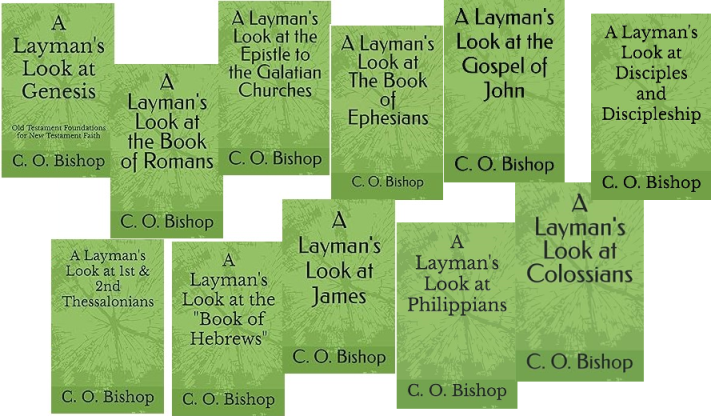
The Layman’s Look Series: Learning to Study God’s Word.
Introduction (For the Entire “A Layman’s Look” Series):
The “Layman’s Look” series (at this writing) includes 14 Bible-teaching books. Twelve of them are commentaries on a single book, or a group of very small books of the Bible. The remaining two are Bible-teaching specifically intended as Christian Training,” All of them are Focused on the profitable application of God’s word, the Bible.
These books are an attempt to look at “The Book” in the same way the initial recipients looked at it. They believed the Bible was God’s Word. They would not tamper with it. But they also saw that it was to them…God wanted them to understand it. These people did not have theological training. They received each of the 66 books of the Bible . They were fishermen, farmers, kings, tent makers, shepherds, soldiers, priests; men and women of all walks. The recipients all had the desire to understand God’s Word, and an honest heart with which to receive it.
A Layman’s Look’s Foundational Truth: The Bible IS God’s Word!
I am going to begin on the foundational premise that this is God’s Word. This carries the idea that, ultimately, all of it agrees. Does that mean that I will necessarily be able to understand all of it? No. But I believe I will be able to gain a general understanding of it all. And, as I work with what I do understand, I believe I can trust Him to teach me the rest.
In learning any discipline, there is a place to begin and a direction in which to increase. This is true, whether the subject is Mathematics, English Grammar, Carpentry, or Welding. The same is true of knowing God, and learning God’s Word. We need to begin somewhere.
You have enough interest to have read this far. Therefore you already have that beginning. You have enough interest to think about Him. Please hold on to that interest, and try to be patient. We will try to maintain a consistent, logical, honest approach to the Bible. Hopefully, we will answer at least some questions to your satisfaction.
The Central Theme of God’s Word
I usually suggest that people begin at the “Beginning,” in the book of Genesis. That’s where God’s Word began telling us His plan. But if a person has a desire to start elsewhere, that’s OK. Ultimately, I feel it is most important to “find hungry people, and feed them.” And part of that involves feeding them when and where they are hungry.
The central theme of the whole Bible is “God’s Redemptive Work in Saving the Fallen Human Race.” That central theme touches on many other themes, but only that theme is covered completely from start to finish. If you want to begin where it touches you personally, you may want to begin with the book of Romans. Or, if you wonder who the historical person of Jesus Christ was/is, then start with the Gospel of John. And, if you are concerned with what the future holds, you may want to try the combination of Daniel and Revelation—but that, I will caution you, is a hard place to start.
If you begin at the “Beginning,” I can pretty well promise that, within a few months of solid teaching, you will have a foundation for understanding the whole Bible, and all the rest will begin to fall into place through personal study.
Here is how the Central Theme of God’s Word works itself out, through the ages:
God’s Redemptive Plan Began Before the Creation
I don’t pretend to understand this, but God has never had any “surprises”—He says he knew us, and He chose us, and He planned our redemption before the foundation of the earth. Hard to grasp? Yes, I think it is! But should it truly be surprising that the Eternal, Almighty God, the Creator of the Universe is “Hard to grasp?” What kind of God would be so limited that humans could assimilate all there is to know about him? We can’t even understand His creation, (or even any given segment of it). How could we begin to understand His motives and choices?
But He wants us to understand at least the facts—he doesn’t demand that we know what makes them all work. When I was a child, my mother taught me to tell time, by looking at the kitchen clock. She never asked me to explain how the clock worked or to explain why an hour has sixty minutes, etc. She just wanted me to be able to “tell time” (this was pre-digital-age). God doesn’t demand that I be able to explain everything about Him. But He wants me to understand Who He is, What He is like, how to know him and walk with Him; and some other things of this sort.
Learning God’s Plan
God created the entire physical universe, and in so doing, He created an environment for us. He also knew that we would fall into sin, and He had made one Provision for that event.
Throughout the ages, He has manifested that one Provision, over and over, in many different ways, all looking forward to the one Person who would bring it all to fruition.
He provided a way for Man to return to Him. That way always involved a Blood Sacrifice (looking forward to the One Sacrifice to come), and it always involved Faith. Adam placed his faith in God’s promise, and God clothed him with the skin of an animal, a substitute for Adam’s life. (God never required that a man fully understand His provision; only that he trust in it.)
Noah expressed his faith (Genesis 6-9) and produced a powerful object lesson for us: the Ark. (Yes, I believe it truly happened…bear with me––) That Ark was protected from within and without—it was impervious to the judgment from without, and from defilement within. It bore the force of Judgment (the Flood), and rose above it, triumphantly, because it was in its nature to do so. Inside, all were saved. Outside, all were lost. People entered by faith, but God closed the door, protecting those within, who had placed their faith in His promise; and prohibiting the entry of those without, who had rejected His promise. All the people inside and outside were sinners…the only difference was that the people inside chose to trust God.
Once the Ark was sealed by God, it and all its passengers were completely dependent upon the provision of God to see the redemption through to the end. There was no sail, nor any means of propulsion, no rudder, or any means of control. No anchor; no compass…in short, no human intervention at all. All rested upon God’s Grace. (I hope this is beginning to sound familiar…)
More Examples
Later on, Abraham expressed that same faith, and God specifically stated that his faith was counted to him as righteousness. (Genesis 15:6; compare Romans 4:3)
Years later, we see the Passover, where, family by family, a whole nation placed their faith in one lamb: one slain for each family. They placed themselves under the covering of that blood, and they were saved from the destruction that fell that night. (Exodus 12:22 It is of special interest to see that, in “striking” the blood onto the lintel and the two door-posts, in that order, they sketched the shape of a cross…1,500 years before the Crucifixion of Christ, and 1,300 years before the Roman invention of Crucifixion as a means of torture and execution.)
A few chapters later, we see the Day of Atonement, where a whole nation placed their faith in a single blood sacrifice, for the covering of their sins for a limited time. (Leviticus 16)
Final Example of The Stated Theme:
Finally, in the Gospel of John (John 1:29), John the Baptist pointed at One Man, and said “behold the Lamb of God, which takes away the sin of the World”.
The people to whom he spoke that day were the Jews: of all people, they ought to understand the concept of connecting a lamb with sin (via sacrifice), but even they could not follow this leap:
Conceptual Problems
In the first place, their (incorrect) understanding seemed to be that salvation was for (and only for ) the Jews…(Jesus later pointed out that it was of the Jews—it came from them, in the person of Himself)…so the idea that it was for the World was foreign to them, though God truly had said so from the beginning.
In the second place, the sacrifices had always just covered sins—the Hebrew word translated “atonement” means “a covering”, and they had correctly understood that their sins were covered by the blood of those sacrifices (by faith…though not all understood that). But John the Baptist said that this Lamb would take away sin. God had promised it in His Word from the first, but it was just too foreign for them, and too incomprehensible, so they had focused only on the covering.
Finally: he was pointing at a Man—how could this Man be the Lamb?? And where was the promised Messiah? Where was the King for whom they had been waiting? How could this be??
“A Layman’s Look” is finding Answers to Our Questions
The answer to these questions is the central message of the whole Bible. And the Story begins in Genesis. You can pick it up wherever you are, but you should know that the Beginning is “In the Beginning… .”
The goal of the whole series, “A Layman’s Look…” is to promote a solid, honest understanding of God’s Word, as God’s Word. I will make every effort to treat it in the literal sense; unless the express intent of the passage is to be allegorical, a parable, or a clear metaphor. When God says in Psalm 1, “He shall be like a tree, planted by the rivers of water, that bringeth forth His fruit in His season…” I do not, thereby, expect a man who meditates on God’s word to “grow bark and leaves,” and to physically become a tree.
There is a clear simile stated: “He shall be like…” There are other similar passages, where God is compared to a brood hen, protecting her chicks; or, a refiner’s fire, purifying silver; or a fortress, a refuge from enemies.
I have no problem recognizing the metaphors and similes in these passages. But unless the context clearly shows the metaphorical intent of a passage, I will be taking it as literally as seems to be the intent. I believe that is how the original recipients treated the Word of God, and I intend to emulate them in this regard.
May God bless your faithful Reading and Study of His Word.
Chet Bishop, 2018 (Revised and updated 2026)